1. The Limitation of Reactive Stability Control
Traditional ESC (Electronic Stability Control) systems evaluate sensor data reactively: once wheel slip or a heading angle deviation is measured, brake force or torque reduction is applied. At track speeds exceeding 250 km/h, reactive corrections come too late to maintain maximum cornering velocity.
2. High-Frequency 1,000Hz Neural Loop Architecture
By deploying embedded Automotive Safety Integrity Level D (ASIL-D) microprocessors running lightweight deep neural networks, telemetry data is evaluated 1,000 times every second. Sensors monitor optical ground velocity, steering column torque angle, individual wheel hub acceleration, and tire surface infrared temperatures.
AI Telemetry Hardware Specs
-
Loop Execution Frequency1,000 Hz (1 ms response time)
-
Processor TOPS Rating128 Neural Compute TOPS
-
Sensors Processed Per SecondOver 1.4 Million Data Points
-
Torque Micro-Adjustment Granularity0.5 Nm Precision
3. Real-Time Track Friction & Tire Load Modeling
The AI dynamic engine continuously estimates the friction coefficient ($\mu$) between the tire contact patch and track surface. As tires heat up or asphalt quality varies through a corner, the vehicle dynamically recalibrates active damping rates, wing attack angles, and front/rear electric torque split before slip ever develops.
4. Cloud Telemetry Integration & Continuous Learning
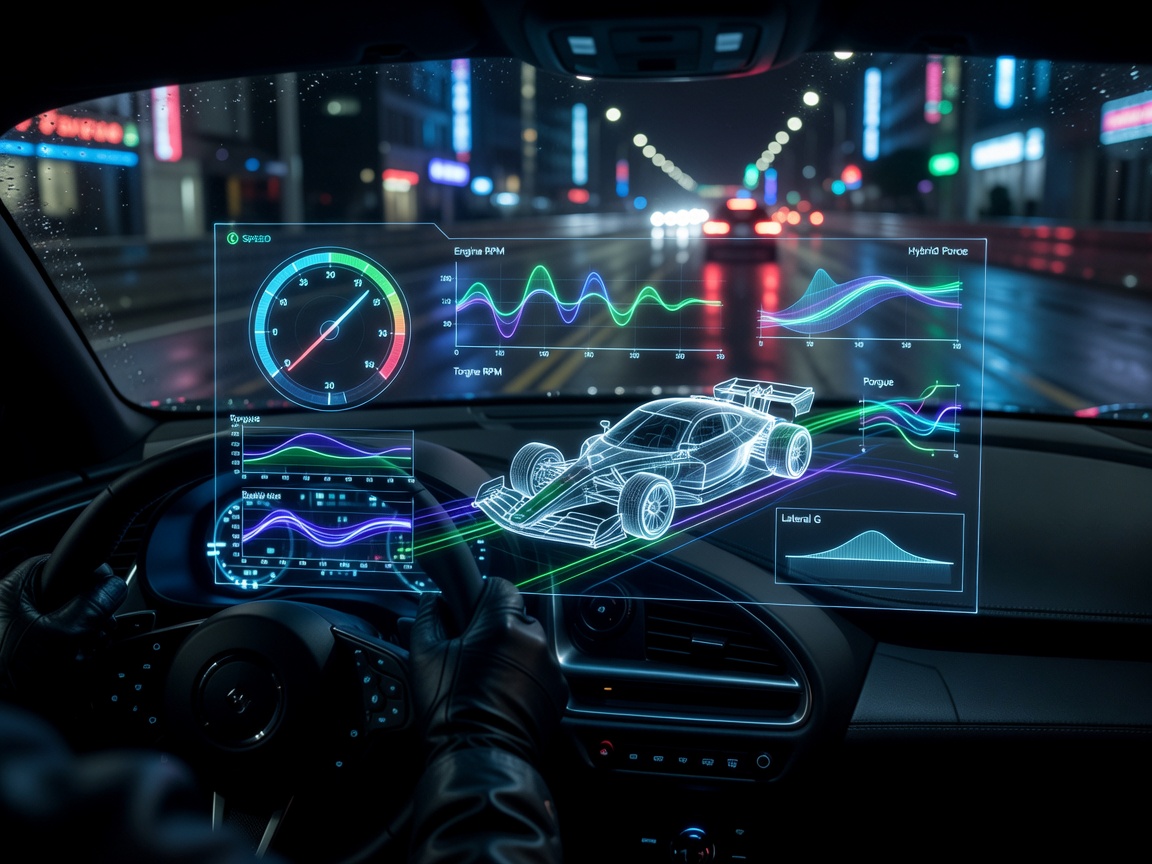
When connected to pitlane high-speed 5G networks during track sessions, session lap data is synced to cloud servers where deep learning models synthesize optimal lap telemetry, providing drivers with instant thermal degradation and apex speed feedback via digital cockpit displays.