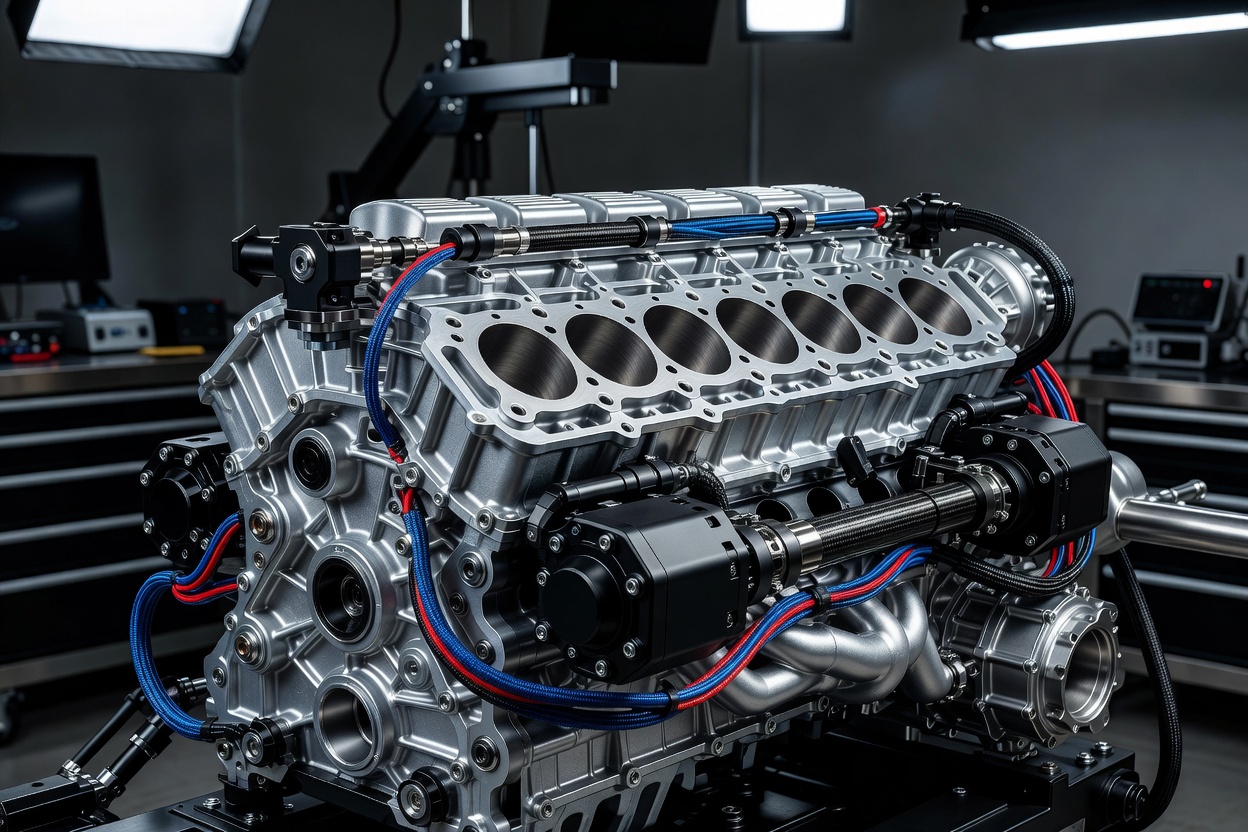
1. The Synergy of Combustion and Axial-Flux Motors
The modern hypercar powertrain is an engineering marvel. Rather than replacing internal combustion engines, high-voltage electrification is deployed to eliminate the inherent low-end torque latency of high-RPM naturally aspirated V12 engines. By placing twin axial-flux electric motors on the front axle and a third motor inside the dual-clutch transmission, engineers achieve all-wheel drive with zero mechanical drive shaft connection between axles.
2. 900-Volt Silicon Carbide Electrical Architecture
Operating at 900 volts allows current flow to be reduced significantly while delivering megawatt-level energy spikes. This drastically reduces the required wiring copper thickness and battery heat dissipation requirements. Silicon Carbide (SiC) inverters switch electrical frequencies at up to 100 kHz, achieving over 99% inverter efficiency and minimal thermal power degradation under track conditions.
Powertrain Benchmark Telemetry
-
ICE Output Power835 HP @ 9,250 RPM
-
Combined Electric Motor Output380 HP (Tri-Motor Setup)
-
System Voltage Rating900V Architecture
-
0-100 km/h Acceleration2.1 Seconds
3. Immersion-Cooled High-C Battery Cell Technology
Unlike standard electric passenger cars that focus on range energy density, hypercar hybrid batteries prioritize power density. Utilizing direct cell-immersion dielectric fluid cooling, the battery pack can discharge and re-absorb up to 300 kW continuously without exceeding critical operational thermal thresholds.
4. Torque Vectoring and Regenerative Energy Recovery
During corner entry, the front electric motors apply independent negative torque to the inner wheel while delivering positive torque to the outer wheel. This active yaw moment rotates the chassis with surgical accuracy, while recovering kinetic energy directly back into the ultra-lightweight battery matrix.